BLOGGER TEMPLATES AND TWITTER BACKGROUNDS
by D.W. Lundberg

Showing posts with label TRANSFORMERS. Show all posts

Wednesday, December 10, 2014

... FOR "RANDOM UPDATES TO THE SITE"

When I first embarked on this blogging adventure in February of 2010, I'll admit I was a novice at it in more ways than one. Learning to let my freak flag fly, for one thing, figuring out how to stand toe to toe with (and sometimes head and shoulders above) the millions of other movie blogs out there, by offering up a different spin on the basics of filmcraft - technique, trivia, retrospectives, reviews - than you're probably used to. Or struggling to stay relevant, by paying respect to the films of the present (which, let's be honest, is all people really want to hear about) and also to the films of the past (which, let's face it, is where all modern motion pictures get their ideas). Also learning that you can't be everything to everyone all of the time; sure, people love their Comic Book Movies and their MacGuffin With Egg, but try blogging a quiz or two (or three, or eight), and readers will have nothing to do with it. (It took me too long, perhaps, to realize that once one person responds with the answers, it's pretty much pointless for everyone else.)

Still, the thing that's disappointed me the most is that I haven't been able to build up an audience to the degree I'd initially hoped for. I have my core readership, of course, to whom I'm eternally grateful. Ultimately, though, the responsibility of bringing traffic to the site rests entirely on me, and only me, and I've been slow in making that happen. Never one to toot my own horn, I was uncomfortable at first posting updates to Facebook, or anywhere else for that matter, expecting, I guess, to succeed on the strength of my words alone. But it takes a certain amount of shameless self-promotion to make it anywhere in this world, a fact I've only started warming up to, and now that I've started posting to Twitter and Medium.com, we'll see what that does for the site. (Special thanks to Ether Ling for crafting a marketing plan to help bolster the blog.)

Tuesday, January 14, 2014

... FOR "SHIA LaBEOUF-ISMS" (OR, "HOW TO PLAGUARIZE OTHER PEOPLE'S WORK AND PAY THE PENALTY FOR IT") - UPDATED!

Actor/rabble rouser/fledgling filmmaker Shia LaBeouf got himself into a bit of hot water last month, when the former Transformers star was accused of plagiarizing someone else's work for HowardContour.com, his 12-minute short about the trials and tribulations of an Internet movie critic. Just to be clear: LaBeouf flat out stole the plot of Daniel Clowes's 2007 comic book Justin M. Damiano, including specific frames and entire lines of dialogue, and tried passing it off his own. (Clowes's name is conspicuously absent from the film itself, and never once during interviews did LaBeouf mention Justin M. Damiano as his source material.)

Wednesday, July 31, 2013

... FOR "CINEMA STAPLES AND THE MYSTERY OF THE RECYCLED CAMERA SHOT"

Making movies is hard. In fact, with so many factors at play - script, acting, editing, costume and set design, cinematography, not to mention escalating budgets and ever-tightening production schedules - it's a wonder studios manage to churn out coherent films at all. It takes an enormous amount of talent and patience and all-around singularity of vision to pull off what most directors do; that much is to be admired. Like the rest of us, though - those burdened by countless responsibilities throughout the course of our days - they are only human, and prone to make mistakes. Continuity errors, say - the placement of objects or actors mismatched from one camera shot to the next. Or repeated auditory motifs, which not only hearken back to Hollywood's long and illustrious past but also take us out of the movie itself - so that, when we hear them, we are self-consciously aware that what is unfolding before us is, in fact, only a movie.

The process of editing a film might also pinpoint mistakes not evident during actual production. A missing close-up or establishing shot, for instance, which would otherwise clarify narrative action. A director is then faced with a number of choices: one, he can rustle up the necessary approvals and crew to travel back and get that shot; two, he can skip the shot entirely, and risk confusing his audience; or three, he can find a suitable replacement shot, preferably of something already filmed. Most directors, because of time and money constraints, will often re-use or alter specific shots to suit their particular needs. Let's call this the mystery of the recycled camera angle - a repeated shot, used twice within the same film, to cover up a piece of missing footage.

Monday, July 1, 2013

... FOR "SUMMER OF THE UNOFFICIAL REMAKE, 2013"

If our current summer movie season had a theme - I know, I know, it's only been a couple of months, yet already one has started to shake itself out - it might be The Summer Of The Unofficial Remake, Whether Its Makers Care To Admit To It Or Not. Of the season's biggest studio releases, at least a dozen of them - Iron Man 3, Star Trek Into Darkness, Fast And Furious 6, Man Of Steel, Monsters University, World War Z, White House Down, Despicable Me 2, The Lone Ranger, R.I.P.D., RED 2 and The Wolverine - seem cobbled together from the spare parts of previous films. Most, obviously, just happen to be sequels and/or prequels to popular franchises (or, in Star Trek's case, a sequel to the reboot prequel). But that's no excuse for the amount of literal scene-stealing going on now at your local multiplex.

The saying goes, of course, that there's nothing new under the sun. And this is true, to a point (as David Bordwell astutely says here, even box office behemoths like The Godfather, Star Wars and Raiders Of The Lost Ark took previously-established Hollywood genres and made them bigger and better). I've even written about films that take entire plots from other films and try to pass them off as their own - a dispiriting trend in Hollywood, and one that seems to be growing more common by the minute.

Monday, May 27, 2013

... FOR "CARTOON/CELEBRITY DOPPELGÄNGERS"

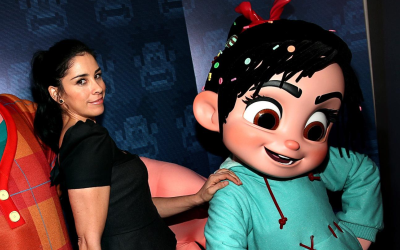
Been on an animation kick as of late, what with ABC Family and The Disney Channel showing Peter Pan, Tarzan and Lilo & Stitch at all hours of the day, plus the kids' incessant playing of Wreck-It Ralph on DVD. It always impresses me how the best cartoon features still have the power to entrance us, even after all these years, with animation every bit as supple as their storytelling.

Even so, we skipped seeing Ralph in theaters - sometimes, it's hard to tell what will and what won't be worth the $40 family trip to the movies - but I imagine it plays just as well at home as it did on the big screen. Disney's 52nd Animated Classic basically does for video games what Toy Story did for toys, with clever cameos and in-jokes for old-school and hardcore gamers alike, and a sugar-sweet story at its center. What I like most about it, though, are the vocal performances - namely from its two main stars, whom you wouldn't normally associate with kid-friendly fare.

Thursday, April 19, 2012

... FOR "CG ATROCITIES (AND THOSE WHO COMMIT THEM)"

Confession: I don't care much for CGI. At least not in the way most filmmakers tend to use it these days, which is too much and too often. Like any cinema tool – music, art direction, cinematography, editing, costume design, even A-list actors – special effects should always be used as a means to support a story, not as the focus of it. And it's a shame how so many people have apparently lost sight of that.

Granted, it's a tricky mix to get just right. While some directors seem to get it (Steven Spielberg, Christopher Nolan, even pre-Avatar James Cameron spring to mind), others have simply lost the ability to rely on anything else (cough-George Lucas-cough). We've come a long way since the days of Jurassic Park and Terminator 2, when CGI still had the power to shock and surprise us - to make the fantastical seem fathomable. Now that anything and everything can be accomplished via CGI, from exploding planets to spaceships to kitchen utensils to tabletops, my question is: Should it?

Saturday, February 25, 2012

... FOR "HOLLYWOOD'S BIGGEST NIGHT" (aka "OSCARS 2012") - UPDATED!


UPDATE: One word for the show last night: "Yawn." Anyone disagree? Despite an admirable effort from Mr. Crystal, watching The Artist win for Best Picture was like the surprise everyone saw coming. I admit I DVR'd the entire show just so I could fast-forward through all the stodgiest parts (Best Documentary Short Subject, anyone? "In Memorium"?), but other than Angelina Jolie's right leg, there was nothing particularly memorable about the entire night. Better luck next year, Oscars!

It's Oscar time again, dear readers! And to kick off our third annual All-Things-Oscar post here at FTWW, I thought I'd pose a question to you: How many of this year's Best Picture contenders have you actually seen? The Artist, The Descendants, Extremely Loud & Incredibly Close, The Help, Hugo, Midnight In Paris, Moneyball, The Tree Of Life, War Horse – all fine films in their own right, though hardly the types you'd find crowding up your local multiplex on weekends.

Saturday, July 9, 2011

... FOR "FRANCHISE FACE-OFFS (PART 5 - 'TRANSFORMERS' EDITION)"

Michael Bay is the devil. Or, wait, let me explain. If everything that's good and wholesome in this world must have an opposite, then by "devil," I mean Michael Bay is the antithesis of everything the movie gods hold dear – coherency of plot, characters who resemble actual human beings, and most of all, film footage that hasn't been edited together with the skill and proficiency of a jackhammer. Bay's style of filmmaking seems geared toward people with attention-deficit disorder: explosions, gunfire, more explosions, hot-bodied men and women parading lasciviously past the camera every 6-7 seconds (or less), as if smacking you in the face to make sure you're paying attention. It's juvenile, and watching his movies, I'm insulted at the notion that my brain needs to be under constant assault to feel entertained.

I guess on some level, you have to respect what the guy does. There's a market for this sort of thing, for better or worse (Bay's films have grossed over $3 billion worldwide), and he plays to those strengths well. Born in Los Angeles in 1965, Michael Benjamin Bay started his film career early on, when he interned at Lucasfilm at the age of fifteen. He majored in English and Film at Wesleyan University, attended Pasadena's Art Center College of Design for his graduate studies, and started directing music videos and television commercials after receiving his degree.

Thursday, June 10, 2010

... FOR "CASTING SHIFTS AND THE PLOTS THAT SUFFER BECAUSE OF THEM"

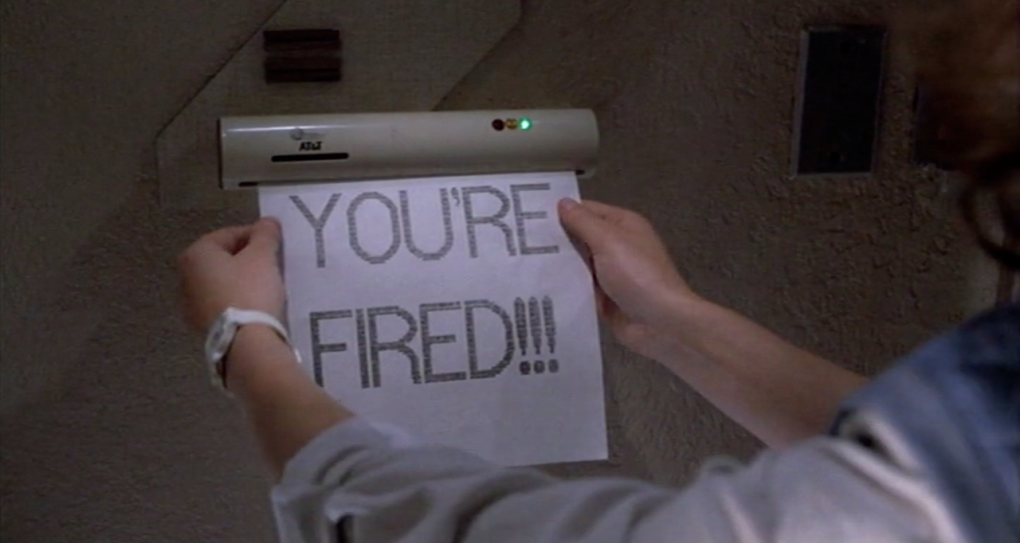
Back To The Future Part II (1989)

I may be jumping on the bandwagon a little late here (as usual), but has anyone who's read this particular story had the same reaction as mine? (Or, when you do click that and read it, will you?) Megan Fox? Dropping out of Transformers 3? The horror! How can this be?

I guess I shouldn't be that surprised. A little perplexed, maybe, but hardly surprised. After all, this is only the latest in a long line of Sequels That Have Replaced Actors Because Of Popularity And/Or Pride Issues. It's a tried-and-true Hollywood tradition that's affected every movie series from Charlie Chan to James Bond to Batman to Don Cheadle stepping in for Terrence Howard in Iron Man 2. It's nothing new. Although to be fair, in this case it seems they aren't simply recasting the role so much as switching love interests altogether. Which is supposed to make the change a little less jarring, I guess. But whatever.

Sunday, April 11, 2010

... FOR "MOVIE DIALOGUE AND 'THE RULE OF THREES'"

Something occurred to me the other day as I sat watching The Princess And The Frog with the kids for the twentieth time. (Good movie, that one. It's always nice when kids latch onto something that doesn't make me want to jab a chopstick in both ears.) Original thought doesn't occur to me all that often, to be perfectly honest, so I thought I'd better get it out there.

You're familiar with "The Rule Of Threes," yes? It's a general rule of thumb based on the assumption that people always remember things better in threes (click here for a more in-depth definition). In screenwriting, the most important use of this rule is the three-act structure, which goes something like this:

   Act One: Main character gets into trouble;

   Act Two: Main character tries to get out of
     trouble, but the more he tries, the deeper he
     gets;

   Act Three: Main character gets out of trouble.