BLOGGER TEMPLATES AND TWITTER BACKGROUNDS
by D.W. Lundberg

Showing posts with label MICHAEL KEATON. Show all posts

Friday, February 20, 2015

... FOR "HOLLYWOOD'S BIGGEST NIGHT" (aka "OSCARS 2015") - UPDATED!

UPDATE: Well, it seems Cracked was absolutely right. In a move that should surprise absolutely no one in retrospect, Oscar bestowed Eddie Redmayne and Julianne Moore with Best Actor/Actress honors at last night's 87th Annual Academy Awards, for playing disease-ridden screen characters and/or historical figures. Moore's win is especially grating, not because she didn't deserve it, but because she's already given at least a half dozen worthwhile performances, and since this year she happened to play a Columbia University professor suffering from Alzheimer's, the Academy finally decided to give her her due. (Like Meryl Streep in The Iron Lady, Moore was awarded for a film people respected but didn't particularly enjoy.)

As for the rest, I guess I really shouldn't be too upset that Birdman took home top honors for Best Picture, Director and Original Screenplay. It is, after all, a terrific entertaiment, with stellar performances and knockout cinematography. But its meta-tale of artists under pressure is as old as Fellini's , and the illusion that it's all shot in one long, uninterrupted camera take has been pulled off before, in Sokurov's Russian Ark and Hitchcock's Rope. I'm convinced more than ever that every film today is a copy of something else, and that the only thing "original" about them is the way their stories are told.

So why didn't Boyhood win the Oscar for Best Picture? As far as I'm concerned, it was the only film released last year that broke ground in any way, this 12-year odyssey, shot with the same actors, of a boy growing up and the "moments" that make up his life. The movie may seem uneventful to the average viewer, but then again that isn't the point. (The point is: What do you do with the moments that make up your life? Do the curve balls steer you in the right direction or hold you back?) Boyhood was a labor of love for its director and actors and everyone else involved, and no other film aimed higher or accomplished more by saying so little. And that will be cherished and remembered decades from now while everything else fades into oblivion.

As for the show itself, we were attending a family function so I really didn't get to see much of it. But I managed to stick around long enough to hear host Neil Patrick Harris say of the Oscars, "Or, as I like to call them, the Dependent Spirit Awards." That pretty much summed it all up for me.

A (relatively) short one today, since you've no doubt already formed an opinion of what the Academy Awards do or do not mean to you at this point. To sum up the blog's annual stance on the subject, the Oscars a) are really nothing more than a glorified high school popularity contest, b) pride themselves on celebrating that old "independent spirit," c) sometimes rally around a unified theme, d) try to seem "edgy" and "of the moment" only to revel in time-worn clichés in the end, and e) celebrate everything that's mediocre about American film. And yet, without fail, something will compel me to tune in, at least for a bit, to see if all the tried-and-true traditions still hold. If you can resist the temptation to check out even a part of the telecast for yourself (and, let's be honest, who couldn't use a little Neil Patrick Harris fix every now and then?), then congratulations, you're a better person than I am.
Monday, October 20, 2014

... FOR "COINCIDENCES AND CROSSOVERS" (OR, "THAT TIME YOUR FAVORITE CHARACTER FROM SOME OTHER MOVIE ALSO POPPED UP IN...")

Our previous post on Disney's Maleficent leaned a little on the heavy side, so today I thought we'd try something lighter and more trivia-centric...

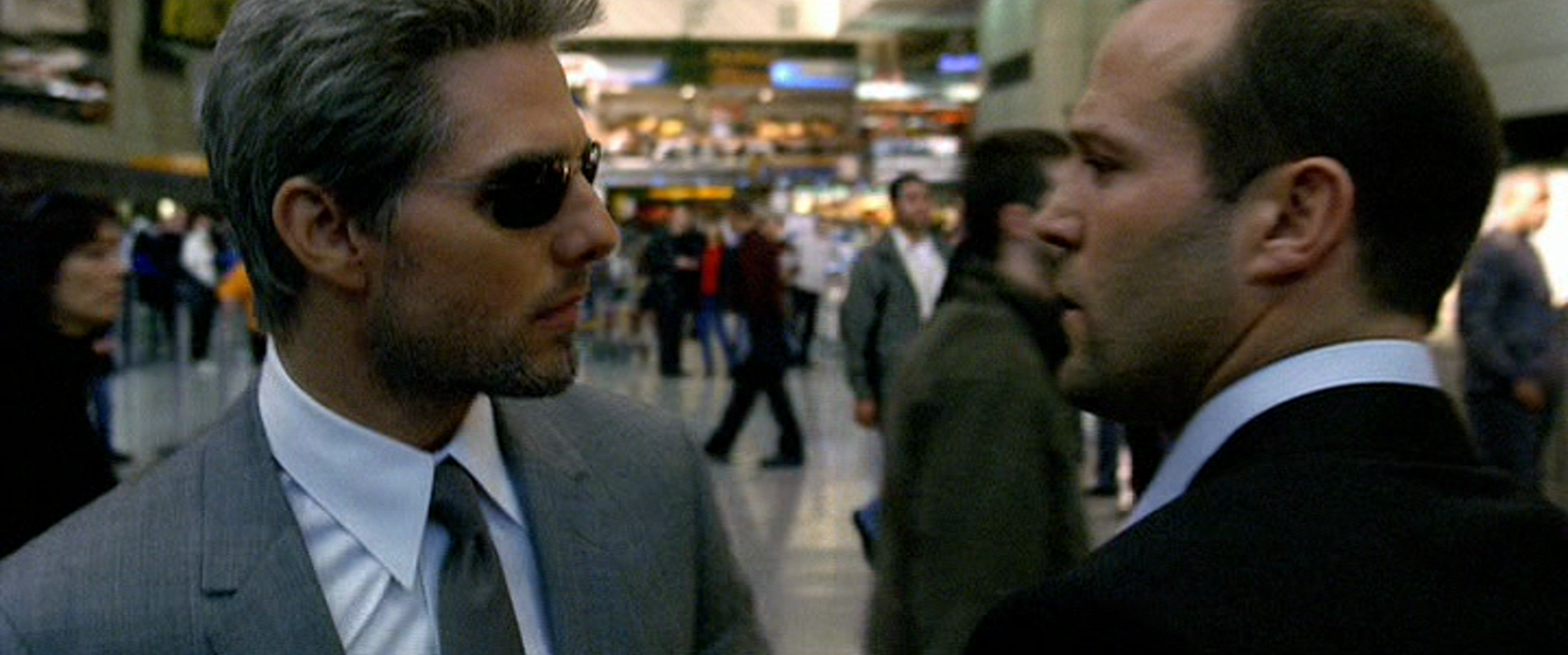
Watching Collateral the other night, I was struck again by the simplicity of its script, the amazing clarity of its high-def digital photography, the way Michael Mann is able to wring supple, nuanced performances from his two stars, Tom Cruise and Jamie Foxx, and... holy crap, is that Jason "Lock, Stock and Two Smoking Barrels" Statham switching briefcases with Tom Cruise at the beginning of the movie? Or did my eyes just deceive me? The man may only show his face for about 15-20 seconds or so, but... yep, a quick scan of IMDb shows that Statham is indeed in the movie (credited only as "Airport Man"). My interest piqued, I check IMDb again, and see that Statham's Collateral cameo comes only one year after The Italian Job (2003) and two years after The Transporter (2002). So he'd already made a name for himself by the time 2004 rolled around - why such a bit part in an otherwise major motion picture? Was it a favor to the director? A favor to Cruise? A way of passing the baton from one action hero to another?

Saturday, December 8, 2012

... FOR "IMAGES ('BATMAN' 1989-97 EDITION - PART FOUR)"

Part Four of our Burton/Schumacher retrospective, in which we take a visual tour of the 1989-97 series' special (and not-so-special) pleasures.

One truism about comic books - or any serialized form of entertainment - is that they're always in flux. Readership dwindles, tastes splinter off and mature, and publishing houses find themselves in a constant struggle to stay one step ahead of the public - to remain pertinent, say, or keep current with the ever-changing media climate. It's why we have so many iterations, spin-offs and incarnations of the same old titles: to please any number of fans at any given moment.

Tuesday, October 23, 2012

... FOR "IMAGES ('BATMAN' 1989-97 EDITION - PART TWO)"

Part Two of our Burton/Schumacher retrospective, in which we take a visual tour of the 1989-97 series' special (and not-so-special) pleasures.


It was the summer of 1989, and the hype was inescapable: backpacks, posters, video games, candy dispensers - you couldn't walk two feet without bumping into Batman paraphernalia of some kind. (According to this report, Batman merchandise earned over $500 million in retail that year.) Little did marketing pundits realize that the Caped Crusader's long-awaited return to theater screens would turn out to be such a pop culture phenomenon; Premiere magazine, in fact, in their annual summer box-office prediction issue, guessed that Batman would place 3rd - after Ghostbusters II and Indiana Jones And The Last Crusade, respectfully - in ticket sales from May to August. (Tim Burton's block-busting juggernaut wound up grossing $251.2 million in the U.S. - $54 million more than Crusade, and $138 million more than Ghostbusters.)

Standing outside the Alpine Cinema in Brooklyn with my aunt and uncle, you could feel the anticipation crackling in the air. It was midnight on June 24th (getting tickets on opening day was next to impossible) and I can tell you the crowd wasn't just there to watch a movie - they came to be part of an event, a communal experience unlike anything since the original Star Wars. That same excitement carried into the theater too. New York audiences have always been a little more... rambunctious than other places, but this was something different. They cheered when the lights went down. They cheered when the "Batman" title card came up on the screen. They hooped and hollered at the first appearance of the Batmobile. And they rose to their feet and applauded when the lights came up again.

Tuesday, October 16, 2012

... FOR "IMAGES ('BATMAN' 1989-97 EDITION - PART ONE)"

As it often happens when I write for the blog, my thoughts have a nasty habit of getting away from me. Sometimes a particular format will steer me in the opposite direction, or change the particular theme, of a piece that I'm writing. Most times, the final published post will end up looking drastically different from what I originally intended. How, for instance, do I adequately express my undying affection for a certain caped crusading comic book character when the article in question is so clearly about all the behind-the- scenes politics that brought him to the screen?

The Burton/Schumacher Batmans have always held a peculiar fascination for me - not just for how much they got "right" but also for what they got so blatantly, emphatically "wrong." Story-wise, they're a mess, with almost total disregard for comic book canon. Visually, though, they are a triumph - a textbook case of style over substance. (Even Batman & Robin, for all its gaudy garishness, in never dull to look at. Especially with the sound turned off.)

Monday, October 1, 2012

... FOR "FRANCHISE FACE-OFFS (PART 14 - 'BATMAN' EDITION)"

He is the antithesis of Superman in almost every way: dark, brooding, prone to violence (all in the name of justice), and powered only by his sheer determination and will. He is a detective, a scientist, a master strategist and multiple martial arts expert. And his rogues' gallery - the Joker, the Riddler, Catwoman, Two-Face, Scarecrow, The Penguin, Poison Ivy, Mr. Freeze - is unprecedented among comic book heroes. Yet despite his accomplishments, despite all his formidable skills, Batman's greatest battle has always been with Hollywood itself.

Bruce Wayne and his menacing alter ego were created, in fact, as a blatant attempt to cash in on Superman's success. The brainchild of 24-year- old artist Bob Kane (with an uncredited assist from writer Bill Finger), "The Bat-Man" made his first appearance in Detective Comics #27 during May of 1939, and was an immediate hit. (National Publications - soon to be known as DC Comics - now had two popular comic book characters under their belt, having also published the monthly adventures of the Man of Steel.) A self-titled series debuted in April 1940, followed by a 15-part film serial starring Lewis Wilson in 1943, followed by a second 15-chapter serial in 1949, starring Robert Lowery as Batman and Johnny Duncan as Robin.

Batman's popularity soared during the late 1960s, when Twentieth Century Fox's high-camp Batman television series premiered in January 1966. It was a tongue-in-cheek parody of superhero tropes, produced by William Dozier and starring Adam West and Burt Ward (plus a bevy of 60's stars as "guest" villains), and it's this incarnation - for better or worse - that defined the character for the next twenty years. No longer a lone, mysterious creature of the night, Bob Kane's creation had now been reduced to a figure of fun, dancing the Batusi and POW! BOFF! and ZWAP!-ing his way through Gotham City while a bright-eyed, green-bootied Boy Wonder spouted catchphrases by his side. This reputation had ingrained itself so much into the public consciousness that Hollywood producers were literally dumbstruck at the idea of bringing Batman back to the screen.


Friday, June 25, 2010

... FOR "SEQUEL-ITIS AND 'TOY STORY 3'"

So. Toy Story 3. I've been letting it sink in for the past few days now, and here's what I think: as a sequel to my favorite animated franchise, it doesn't quite soar to the same heights as its predecessors (the writing's a tad lazy on a couple of fronts), but nevertheless acts as a lovely and moving coda to the series that began Pixar's cinematic legacy.

The original Toy Story – and I believe this just as strongly now as I did when the movie was released back in 1995, the year I graduated from high school (!) – is this generation's Snow White And The Seven Dwarfs. Sure, we knew (computer) animation had been around for a while, but we didn't know it could do thatIt also came as a firm announcement of the Pixar model: story first, everything else second. (Any movie can wow you with its technique, acting or special effects, but if the story's a bust there's really no point.)