BLOGGER TEMPLATES AND TWITTER BACKGROUNDS
by D.W. Lundberg

Showing posts with label REBOOTS. Show all posts

Friday, May 15, 2015

... FOR "CRASHING PLANES AND SUPER-RESCUES"


On Wednesday, CBS released the extended trailer for their upcoming Supergirl series (set to debut this November), to general acclaim from fanboys and network nitpickers alike. Developed by Greg Berlanti (whose production company also oversees The Flash and Arrow for The CW) and Ali Adler (ABC'S No Ordinary Family), Supergirl stars Melissa Benoist as Kara Zor-El, Superman's Kryptonian cousin, who, "after 12 years of keeping her powers a secret on Earth, decides to finally embrace her superhuman abilities and be the hero she was always meant to be." In short, it's your typical superhero origin story, on a TV budget, with all the comic book existentialism and witty romantic comedy banter we've come to expect from our modern-day pop entertainments.

For her part, Benoist captures the cheerfulness and naivete of the character quite well, thank you very much, especially during the action scenes - check out her obvious glee, for example, at 4:35, when she discovers she's bulletproof. (Speaking of Glee: Benoist and her Flash counterpart, Grant Gustin, are both veterans of Fox's musical melodrama.) The writing, too, takes obvious delight poking at gender stereotypes ("What do you think is so bad about 'girl'? I'm a girl, and your boss, and powerful, and rich, and hot, and smart. So if you perceive 'Supergirl' as anything less than excellent, isn't the real problem... you?"), and, of course, includes its share of Easter Eggs.

Wednesday, April 15, 2015

... FOR "THE MASCULINIZATION OF DISNEY PRINCESSES (A VISUAL GUIDE)"

As the Disney live-action remake/cartoon nostalgia train rolls on (this morning, Sir Ian McKellan posted this report from the Beauty And The Beast table read), I thought we'd take a gander at the effects these films have had in our current pop culture climate.

Tim Burton's Alice In Wonderland (2010) came first, of course - a (some would say) drastic re-conceptualizing of the animated Disney classic, with Johnny Depp as a bug-eyed Mad Hatter and Helena Bonham Carter suffering from the most horrifying case of elephantiasis ever captured on film. Next, Universal took a crack at the fairest one of them all with Snow White & The Huntsman (2012), starring Charlize Theron and Kristen Stewart. Then in 2014, Disney earned themselves a mint by casting Angelina Jolie in Maleficent, a faux-feminist retelling of Sleeping Beauty from the POV of the villain. And while I didn't much care for Maleficent ("This is an ugly, embittered film on many levels," I wrote here, and I stick by that - just not for the reasons you'd expect), I did pick up on a strange sort of trend that popped up at the end of all three films - namely, the desire to turn beloved Disney princess-types into pant-wearing warriors.

Friday, February 27, 2015

... FOR "A TALE OF TWO 'POLTERGEIST'(S)"

UPDATE: Via this report from Variety.com, MGM and 20th Century Fox have moved up the release date for Poltergeist to May 22, 2015. The article that follows remains unaltered from its original post.


Excuse me for sounding a little churlish, but the newly-released trailer for 20th Century Fox's Poltergeist remake has my stomach in knots, and I don't mean in a good way. The film, which opens July 24th, has been touted as "a revisionist take" on Tobe Hooper's 1982 horror classic, with "modern" updates including cell phones and flat-screen TVs. Which is fine, I guess - I mean, this is Hollywood, after all, where people aren't truly happy unless they're busy ripping off someone else's work or exploiting the latest adventures of the world's greatest superheroes. And this is hardly the first time Sam Raimi's Ghost House Pictures label has tried rejiggering a modern classic, with remakes of The Grudge and The Evil Dead burning up theater screens in 2004 and 2013, respectively. My question, though: what's the point in remaking something if you don't have anything new to bring to the table? Why reproduce the same thrills and chills if you can't be bothered to give a fresh spin on old material?

Despite the change in cast (Sam Rockwell and Rosemarie DeWitt make fine replacements for Craig T. Nelson and JoBeth Williams from the original movie), the new Poltergeist looks to be a rehash of the same exact plot - close-knit family moves into suburban home and is immediately beset by supernatural forces. Again, this is nothing new. Remakes have been a part of our cinematic diet since the days of the earliest films, when Cecil B. DeMille remade his 1914 silent The Squaw Man in 1918 and again in 1931. (Trivia bit: DeMille also directed a silent version of The Ten Commandments in 1923, then later reused some of the same props and sets for his 1956 remake.) True, the marketing gurus behind Poltergeist 2015 could be deliberately trying to goad us into seeing the new movie by plumbing our nostalgia for the previous one. And yes, the final film as released could be entirely different from what the trailer lets on. But the fact that so many elements come directly from Hooper's version suggests a paucity of imagination on the filmmakers' part.

Friday, February 13, 2015

... FOR "GREAT SCENES IN OTHERWISE CRAPPY MOVIES" ("THE AMAZING SPIDER-MAN 2" EDITION)

There are good movies and there are bad movies. There are bad movies with pieces you admire and good movies with scenes you'd be happy to do without. And it's hard to tell which is worse. I vote the former, because any stinker that seems to get so much wrong from the outset is only that much more frustrating when you catch glimpses of its greatness - those moments, however fleeting, where its makers have an absolute grasp of their material. It's scenes like these which we'll highlight for the purposes of this series.

I apologize if I've been harping on Sony Pictures' rebooted Amazing Spider-Man series a little too much as of late. I don't mean to sound like some disgruntled fanboy, unhappy with even the slightest attempt at "modernizing" everyone's favorite web-slinging superhero for the silver screen. Watching them mishandle the property so spectacularly for so long, however (I'm talking about 2007's woebegotten Spider-Man 3 and onward), it's only natural that the reboot became the proverbial punching bag among comic book-to-movie franchises, especially in lieu of Marvel Studios' continued dominance at the box office. (Which is what makes Sony's recent decision to "loan" Spider-Man out to Marvel such an exciting prospect - if you're going to reboot the character, you might as well give it to people who know what they're doing.)

Monday, September 29, 2014

... FOR "DISNEY'S 'MALEFICENT' AND THE FARCE OF THE FEMINIST FAIRY TALE"

"In any event, we know what's really going on in the scene.... It's a symbolic assault with sexual overtones, specifically an attack that occurs after a woman has passed out. Maleficent doesn't just lose her wings; they're stripped from her, against her will."
  — Matt Zoller Seitz, rogerebert.com

"[A]fter the brutal attack, Maleficent quickly retools itself, heading into a whirlwind of tones while ignoring the darker implications of its opening story. In a brisk 97 minutes, decades of narrative are distilled into boilerplate genre elements: The chills of a rape revenge fantasy, the mirth of slapstick, and the adrenaline of action."
  — Monika Bartyzel, Girls On Film

"[W]elcome to Walt Disney's I Spit On Your Grave."
  — Drew McWeeny, HitFix.com


So intoned the critics of Disney's Maleficent, which (so far) has managed to gross over $756 million since opening May 30th. Many reviews, as a matter of fact, touched on this rape-as-metaphor idea in some form or another, to the dismay of many moviegoers/overprotective parents who outright refused to believe that the Mouse House would sneak such subversively sinister material into one of their patented family entertainments. Never mind that Angelina Jolie herself admitted as much during interviews ("The core of [the movie] is abuse, and how the abused have a choice of abusing others or overcoming and remaining loving, open people," she told the BBC on June 10). The cold hard truth is that, from Hans Christian Anderson to Charles Perrault to the Brothers Grimm, even our fondest fairy tales have always been metaphors for something. What matters is how those metaphors are presented to the eyes and ears of anyone old enough to comprehend them.

Friday, June 6, 2014

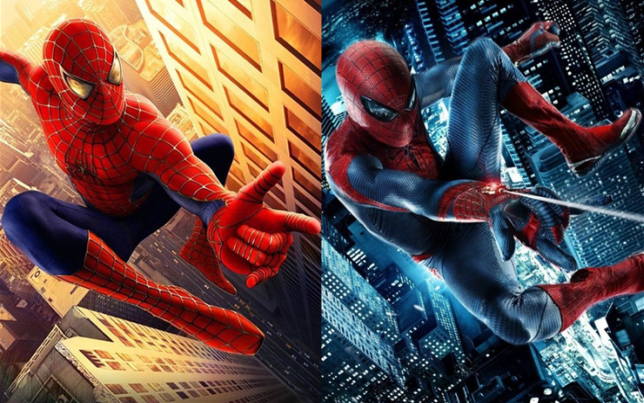
... FOR "A TALE OF TWO SPIDER-MAN(S)"

And again I find myself facing a conundrum: How, exactly, do I express my ardor and affection for one of the world's greatest comic book characters within the confines of a single blog post? Answer: I don't. As I've mentioned elsewhere on this site, simply talking about film, writing about it, isn't enough to do it justice. For what are motion pictures if not a purely visual medium? That's especially true of Comic Book Movies, which, like their source material, are meant to be experienced visually. Where's the fun, for example, in describing a scene from Sam Raimi's Spider-Man - in which all the characters show up for Thanksgiving dinner wearing each other's colors - when I can simply show it to you instead?

It may seem hard to believe, but Raimi's original Spider-Man turned 12 years old just this month. Harder still when you realize his entire Spider-Man trilogy lasted only five years, from 2002-2007. Together, they've grossed over $2.4 billion at the box office worldwide. They undoubtedly did their part to shape the current Comic Book Movie climate as we know it. And yet, since the 2012 reboot, some of Raimi's choices have been called into question, in particular his decision to skimp on the grittier, more psychological aspects of the character.

Monday, July 1, 2013

... FOR "SUMMER OF THE UNOFFICIAL REMAKE, 2013"

If our current summer movie season had a theme - I know, I know, it's only been a couple of months, yet already one has started to shake itself out - it might be The Summer Of The Unofficial Remake, Whether Its Makers Care To Admit To It Or Not. Of the season's biggest studio releases, at least a dozen of them - Iron Man 3, Star Trek Into Darkness, Fast And Furious 6, Man Of Steel, Monsters University, World War Z, White House Down, Despicable Me 2, The Lone Ranger, R.I.P.D., RED 2 and The Wolverine - seem cobbled together from the spare parts of previous films. Most, obviously, just happen to be sequels and/or prequels to popular franchises (or, in Star Trek's case, a sequel to the reboot prequel). But that's no excuse for the amount of literal scene-stealing going on now at your local multiplex.

The saying goes, of course, that there's nothing new under the sun. And this is true, to a point (as David Bordwell astutely says here, even box office behemoths like The Godfather, Star Wars and Raiders Of The Lost Ark took previously-established Hollywood genres and made them bigger and better). I've even written about films that take entire plots from other films and try to pass them off as their own - a dispiriting trend in Hollywood, and one that seems to be growing more common by the minute.

Friday, December 14, 2012

... FOR "TRAILER ROUNDUP, DECEMBER 2012"


There's been a strange confluence of movie trailer releases over the past week, as if studios are already vying to one-up each other for Most Anticipated Film of 2013. I honestly can't remember the last time so many big-budget previews came out around the same time; has it now become like the Oscars, where you're forced to submit your entries before the new year rolls around in order to qualify? (FYI, you can expect most of these to debut in theaters along with The Hobbit today.)

That's not to say the movies themselves look like a waste; if anything, they're equally enticing in their own way, depending on your preference for genres. Thanks to The Avengers and The Dark Knight Rises last summer, audiences are primed, I think, to accept nothing less than perfection from their next potential Hollywood blockbuster. And these latest don't look to disappoint.

Friday, September 21, 2012

... FOR "ABANDONED PROJECTS ('BATMAN: FULL CIRCLE' EDITION)"

A break from tradition here at FTTW (as if this was ever a traditional blog to begin with)...

About three years ago to the day, I'd written the introduction to a book I fully intended to finish, about Warner Bros' 1989-1997 Batman franchise and its gradual fallout with the moviegoing public. But like so many things in life, the idea sort of fell by the wayside - another unfortunate victim of my brain trying too hard to tackle too many projects at once. I'd forgotten about it until recently, as I was putting the finishing touches on our latest Franchise Face-Off, so to preface that upcoming post, I thought I'd share the introduction here, so you can fully appreciate the depths of my deepest, darkest obsessions. Think of this as a precursor to the FF-Os as you know and love them today:

__________


BATMAN: FULL CIRCLE

INTRODUCTION

I can't exactly tell you where my obsession with the Batman got its start, or how, but I'm pretty sure it started sometime inside the womb. I say this because I can't honestly recall a time when the character did not play an integral part in my life – when images of his comic book escapades didn't flood my brain on a daily basis, even to the point where I hear the faint flapping of bat wings as I drift off to sleep. (Yes, this happens.)

Friday, August 24, 2012

... FOR "SUMMER OF THE SUPERHERO, 2012"


Now that 2012's summer movie season has ended (Lionsgate's Expendables 2, starring Sylvester Stallone, Arnold Schwarzenegger, Jean-Claude Van Damme and virtually every other 'roided 80's action star you can think of, opened to $28.6 million last weekend, and is arguably the last big-budget "event" movie until October), it's important that we look back and remember what worked, what didn't, and what lessons studio executives had better take to heart as they gear up for Summer '13. There were overachievers (Marvel's The Avengers, $617 million U.S.) and underachievers (Battleship, $65 million), breakout hits (Ted, $213 million) and outright disasters (Rock Of Ages, $38 million); there was also, bless its heart, a 47th Ice Age adventure (Continental Drift, with $150 million stateside, plus another $644 million worldwide). All of these, plus more, warrant a discussion on the modern revitalization of the Hollywood blockbuster...

Thursday, July 19, 2012

... FOR "'THE AMAZING SPIDER-MAN' AND THE ART OF THE CYNICAL CASH GRAB"

Because there's no better way to ring in the release of The Dark Knight Rises than by talking about a competing superhero franchise from a competing motion picture studio...


I was just about to publish some thoughts on Sony's The Amazing Spider-Man last week, starring Andrew Garfield as everyone's favorite web-slinging superhero, when I happened across my friend Drew McWeeny's (second) write-up over at HitFix.com, which pretty much rendered anything I had to say on the subject moot. If you don't mind a spoiler-filled discussion on the plot's more "intricate" twists and turns, then you should really give that a shot, or at least check out Drew's initial review of the movie itself, as it sums up basically everything diehard fans find so frustrating about Spidey's big-screen reboot. (What follows is a slightly modified version of my original piece.)

Wednesday, June 27, 2012

... FOR "TRAILER ROUNDUP, JUNE 2012"


So here we are, not even two months into the summer movie season, and already studios are busy plugging their latest blockbusters scheduled for release after the summer's ended. Leave it to Hollywood, and its Lazy Susan manner of thinking, for keeping this particular gravy train rolling.

Last week, moviegoers welcomed the release of no less than three high-profile trailers - for a reboot, a prequel, and a sequel. Two of these, naturally, trade on your nostalgia for beloved returning characters, while the third assumes you've never even heard of its characters at all. Together, they give us an all-encompassing view of how to approach a potential franchise.

Saturday, March 3, 2012

... FOR "FRANCHISE FACE-OFFS (PART 12 - 'SHERLOCK HOLMES' EDITION)"


Will the real Sherlock Holmes please stand up? The great thing about the original stories by Sir Arthur Conan Doyle is just how much that question is left open to interpretation. Recounted in the first-person by the estimable Dr. John H. Watson, M.D., Holmes's flatmate and partner in (solving) crime, it is next to impossible to tell what the world's "first consulting detective" might be thinking at any given moment; indeed, Watson can only stand back and observe, in awe and wonderment, as that great and fevered brain goes on about its business. If we're lucky, Holmes might even key us in on his investigative process - how, for example, he is able to deduce (correctly) a killer's age simply by the gait in his footprints. More often than not, though, we're left to ponder the evidence all on our own - not just about the mystery at hand, but also about this strange, enigmatic cipher at its center.

This is no doubt why readers have been so enthralled by Holmes's adventures over the years. Doyle published the first, A Study In Scarlet, in 1887's Beeton's Christmas Annual, and even now - four novels and 56 short stories later - we have only pieces of the character's true psychological makeup. What we do know is mostly limited to the external: Watson, upon their first meeting, describes Holmes as well over six feet tall, thin, with a "hawk-like nose" and "sharp[,] piercing" eyes. He is emotionless, distant, prone to fits of manic depression when his mind isn't busied on a case, and is a master of deductive reasoning. He will never miss a chance to remind you of this last important fact.

That's all well and good, but what about the man inside - his hopes, his dreams, his thoughts, his fears? Is there more to him than meets the eye? Or do his actions speak for themselves? Why is he so driven, so intensely focused, so difficult to identify with on a personal level? (Modern theorists attribute this behavior to Asperger's Syndrome.) He's been the subject of countless films, radio adaptations, literary spin-offs, TV series, even a Disney cartoon - each with their own personal take on the character, but sharing one common trait: Sherlock's obsessive love of the chase. And he's just as popular as ever. My, how we love a good mystery man.


Saturday, October 22, 2011

... FOR "FRANCHISE FACE-OFFS (PART 8 - 'LETHAL WEAPON' EDITION)"

In almost every movie romance, there's a thing called the "meet cute," in which a boy and a girl are brought together in some deliberate comic fashion - often the result of an awkward social mishap or hilarious misunderstanding. This is, of course, just their first step toward falling in love: both characters usually come from opposite sides of the tracks, and will spend the rest of the plot bickering and flirting and generally getting on each other's nerves – until finally, at the end, they realize they are Made For Each Other.

Some noteworthy examples of this. In Frank Capra's It Happened One Night (1934), runaway heiress Claudette Colbert meets down-on-his-luck reporter Clark Gable while arguing over a seat on a bus. In Disney's One Hundred And One Dalmatians (1969), Pongo the dog "arranges" a meeting between humans Roger and Anita at the park (they argue for about two seconds before falling into a pond together). In Grease (1978), John Travolta and Olivia Newton-John's "meet cute" doesn't actually occur on screen, but is recounted during a musical number instead ("She swam by me, she got a cramp
" / "He went by me, got my suit damp"). And in 1993's Sleepless In Seattle, Tom Hanks and Meg Ryan don't officially "meet cute" until movie's end – on top of the Empire State Building, no less, on Valentine's Day.

When it comes to the Buddy Film – which, you will recall, follows the same basic plot structure as the Romantic Comedy, minus the romance – the concept of "meet cute" still applies. Oh, the end result may turn out different, but the function of it is the same: to unite two characters with conflicting personalities in some fateful, memorable way, thus setting them at odds with each other for the rest of the movie. (This is otherwise known as "conflict.")


Tuesday, August 16, 2011

... FOR "80'S REMAKE-A-PALOOZA!"


I'm late to the party again, I know, but they announced this last Tuesday (August 9th) and it's been festering ever since: "Lionsgate announces Dirty Dancing remake directed by original choreographer Kenny Ortega." That's right. Dirty Dancing. Patrick Swayze. Jennifer Gray. "(I've Had) The Time of My Life." "Nobody puts Baby in a corner." All that.

To which I say: Whaddup, Hollywood? Why this sudden interest in retrofitting 80's pop culture mainstays for our current attention-deficit millennium? First, there were reboots of Friday The 13th, The Karate Kid, and A Nightmare On Elm Street, and a sequel to Tron. Now we've got trailers for a Footloose remake and a prequel to John Carpenter's The Thing (itself a remake) circling the web. We've got upcoming big-screen recyclings of Conan The Barbarian, Fright Night, and Red Dawn, plus in-the- works retoolings of WarGames, Child's Play, and Sam Raimi's Evil Dead (produced, not coincidentally, by Raimi himself). And that's just as of this writing. Who knows what titles will be announced tomorrow, or next week? It's 80's remake fever!

Thursday, June 16, 2011

... FOR "FRANCHISE CONTINUITY AND 'X-MEN: FIRST CLASS'"


A few notes on X-Men: First Class, now barely two weeks old in theaters. The short review (to be expounded upon in a future Franchise Face-Off): I liked it. The story flows better than it has in the last couple of X movies, it's more character-based than special effects-based, and the performances (particularly from headliners James McAvoy and Michael Fassbender) are respectful to past entries yet add their own wrinkles to the fray. Thinking back on it, though, the idea behind this fifth X-Men adventure confuses me: Is it a prequel? A reboot? Maybe a little of both? The characters are the same (albeit in younger, sprightlier form), the struggles are the same, and yet... the pieces don't match up with the other movies.

Monday, January 3, 2011

... FOR "THE BEST FILMS OF THE DECADE" - PART 10

Genre:

SCIENCE-FICTION/FANTASY


Defined:

Space battles. Time travel. Journeys into the mystical unknown. The Science-Fiction/Fantasy films of 2000-2009 enjoyed a creative and financial resurgence unlike anything since the late 1970s, when Star Wars and Close Encounters Of The Third Kind ruled at the box office. Avatar, The Lord Of The Rings: The Return Of The King, and Pirates Of The Caribbean: Dead Man's Chest passed $1 billion in worldwide grosses apiece, while Return Of The King took home 2004's Academy Award for Best Picture – the first Fantasy film in history to accomplish such a feat. The best genre titles aren't content to wow us with their Utopian futures and wondrous special effects; they also hold up a mirror to the social, political and philosophical issues of our times. They challenge us. The final frontier, indeed.


The Top Five:

5. Star Trek (J.J. Abrams, 2009)

It might be too early to call it a great film, but J.J. Abrams' blockbuster relaunch of the U.S.S. Enterprise is certainly a great entertainment, which dives headfirst into action and never looks back. Like Batman Begins and Casino Royale before them, Paramount returned to the drawing board to offer a fresh perspective on what gave Kirk, Spock, Dr. McCoy and the rest such cross-generational appeal in the first place. Trekkies' hardcore devotion to canon, however, made a complete retrofitting next to impossible, so Abrams and screenwriters Roberto Orci and Alex Kurtzman busied themselves with a time travel plot that's both obvious and ingenious: obvious, because it's been done before, and ingenious, because the physics at play allow them free reign to tinker with the mythology without seriously uprooting the fan base. With its breathless pacing and candy-gloss textured set design, it makes an admittedly cultish sci-fi phenomenon officially "cool" again. And the cast is perfection.


Wednesday, October 20, 2010

... FOR "FRANCHISE FACE-OFFS (PART 2 - 'HALLOWEEN' EDITION)"

The problem with a movie like Halloween – along with, say, The Texas Chain Saw Massacre, Jaws, even Poltergeist – is that the law of diminishing returns tends to corrupt the filmmakers' original intentions. Too often sequels are rushed into production as an excuse to cash in on a title's good name; horror sequels, in particular, generally offer the same scares, the same chills, nothing more – only gorier, at a higher pitch than before.

Released in 1978, and made on a budget of $325,000, John Carpenter's Halloween is the granddaddy of all slasher pics – more than Chain Saw (1973) or Psycho (1960), movies not yet in the Butchered-Horny-Teenagers mold. Written by Carpenter and producer Debra Hill, the story couldn't be simpler: maniac escapes from asylum, stalks victims. Yet the movie's atmospheric scares galvanized audiences hungry for just such a thing. Its reputation built slowly, word of mouth eventually helping to bring its final worldwide box office tally to around $55 million (or $172 million, adjusted for inflation). While hardly what you'd call a blockbuster success by today's standards, this was fairly staggering stuff for a late-70s, low-budget shocker – enough to spawn countless rip-offs and seven (count 'em) sequels, a reboot, and a sequel to the reboot.


Monday, July 12, 2010

... FOR "REMAKES AND REHASHES"

We finally got around to catching the remake of The Karate Kid this week, starring Jaden Smith (son of Will) and Jackie Chan. I was pleasantly surprised by it. The initial story beats are more or less the same, with alterations - some major (mainland China stands in for a substantially less exotic Los Angeles), some minor (here "Mr. Miyagi" becomes "Mr. Han," "Daniel LaRusso" becomes "Dre Parker" and so forth). Then, at some point, this updated Kid takes on a life all its own, and for a good while, the "re-imagining" seems warranted. It helps, for one thing, that the karate's improved; the choreography as featured in the 1984 movie always seemed a little too stagy for my taste, even if it got the point across. For another, Chan's given a little more room to play - I liked how the tragedy in his past closed him off from communication with the rest of the world, and how his time spent with the kid helps bring him out of his shell. The only thing lacking is the tournament climax, which is treated more like an afterthought to all the drama that precedes it (again, it reverts to the exact same beats as the original, and lacks surprise). All in all, though, I'd say it's an improvement on the original.

Which, of course, got me to thinking: What about the cinema's other high-profile remakes? Usually when filmmakers get it in their heads to put a new "spin" on some beloved property, the results are never pretty. Either they miss the point of the earlier film completely, or they flat-out fail to bring any new ideas to the table, and who wants that? I like my originals exactly the way they are, thank you very much.

Sunday, April 11, 2010

... FOR "MOVIE DIALOGUE AND 'THE RULE OF THREES'"

Something occurred to me the other day as I sat watching The Princess And The Frog with the kids for the twentieth time. (Good movie, that one. It's always nice when kids latch onto something that doesn't make me want to jab a chopstick in both ears.) Original thought doesn't occur to me all that often, to be perfectly honest, so I thought I'd better get it out there.

You're familiar with "The Rule Of Threes," yes? It's a general rule of thumb based on the assumption that people always remember things better in threes (click here for a more in-depth definition). In screenwriting, the most important use of this rule is the three-act structure, which goes something like this:

   Act One: Main character gets into trouble;

   Act Two: Main character tries to get out of
     trouble, but the more he tries, the deeper he
     gets;

   Act Three: Main character gets out of trouble.