BLOGGER TEMPLATES AND TWITTER BACKGROUNDS
by D.W. Lundberg

Showing posts with label JAMES CAMERON. Show all posts

Saturday, January 16, 2016

... FOR "CINEMA STAPLES AND THE MYSTERY OF THE MAGICALLY BENDING WRIST"

Method acting is a serious craft. It requires you to commit completely to a role, to surrender to it, to take on every quality and mannerism of the character you're playing - in essence, you "become" the character, inside and out. Developed by Konstantin Stanislavski during the years 1911-1916, then later cultivated by "star" practitioners such as Stella Adler and Lee Strasberg, "The Method," as it's called, emphasizes the importance of emotional truth, conveyed internally and externally by the actor. Yet the demands of immersing yourself that deeply into the mind of a character can also have its negative effects, often to the detriment of your own health or sanity. Famous examples of actors taking their "Method" to the extreme include Marlon Brando, who confined himself to a hospital bed for an entire month to prepare for his role as a paraplegic in The Men (1950); Robert De Niro, who gained a whopping 64 pounds to play aging boxer Jake LaMotta in Raging Bull (1980); and Daniel Day-Lewis, who never moved from his wheelchair during the entire six-week shoot for My Left Foot (1989), learned how to track and kill his own food for The Last Of The Mohicans (1992), and caught a slight case of pneumonia while shooting Gangs Of New York (2002) because he refused to wear clothes that were untrue to the period.

The authenticity of these performances aside, there are limits, of course, to how much an actor is willing to sacrifice for his art. To play a character who returns from the dead, for example, it's probably unnecessary for anyone to die and be resuscitated in order to achieve the "emotional truth" of the moment (that's what the Internet was invented for, people!). The same goes for trying to relive a past sexual or childhood trauma, or resorting to actual drug use for a part, which any medical processional will tell you, is likely to cause more psychological and physical damage than it's probably worth. (I am reminded of a scene from 1976's Marathon Man, in which Dustin Hoffman kept himself awake for three days straight to accurately portray his character's disorientation and terror. When co-star Laurence Olivier heard this, he told Hoffman, "Why don't you just try acting?")

Friday, October 30, 2015

... FOR "HALLOWEEN HORROR PROJECT 2016"

Well, it's Halloween again, folks! That time when we fire up our cauldrons and our jack-o'-lanterns, and line the grocery stores for our Kit Kats and costumes for the kiddos, all in anticipation of everyone's second favorite holiday of the year (or, as we like to call it in the Lundberg home, The Night We Stock Up On Enough Stinking Candy To Last Us Through Easter At Least). It is also the time for movies about ghouls, ghosts, and goblins to flood our cinematic consciousness, and in keeping with tradition here at FTWW, I wanted to do something fun for you guys as a countdown to the big night.

This year, though, I wanted to make it a bit more personal, so instead of offering up a generic list of Horror titles guaranteed to worm their way into everyone's torture chamber at night, I've decided to share 31 (31 - get it?) of the biggest frights of my entire movie-going experience - specific moments from specific films, in order of intensity, which managed to scare the ever-living bejeebus out of me since I first fell in love with movies as a kid.

Sunday, August 23, 2015

... FOR "'ANT-MAN,' 'TERMINATOR GENISYS,' AND THE ART OF DE-AGING ACTORS FOR BIG SCREEN PURPOSES"

If Ant-Man and Terminator Genisys have taught us anything this summer, it's that there's still plenty of life left in our older generation of actors yet. And I don't mean that in the metaphorical, gee-I-never-knew-they-still-had-it-in-them sprightly performance kind of way. After all, Michael Douglas is merely a supporting player in Marvel's latest bid for superhero supremacy, and spends most of his time standing on the sidelines, spouting exposition. Schwarzenegger, too, plays more of an expository machine than killing machine this time out, trying to make sense of so many fractured timelines and cracking jokes about being "old but not obsolete" (though box office pundits might beg to differ on that last one). The problem is, most of our marquee movie stars of yesteryear simply can't compete with the Vin Diesels and Dwayne "The Rock" Johnsons of today - Douglas, for all his vim and vigor, turns 71 this September, while Schwarzenegger celebrated his 68th birthday on July 30 - so they've been "promoted" to mentor roles or crotchety figures of fun in order to stay relevant. For one brief shining moment in both Ant-Man and Terminator Genisys, however, we're reminded of their past glories (and unwithered faces) with the help of some revolutionary CG effects, and the results, for a change, are breathtaking. Never before has a digital face-lift looked so good.

Granted, CGI hasn't always had the best track record for replicating human flesh on screen. Skin tones tend to look plastic, and contrary to popular belief, human beings do not move with the dexterity of stop-motion animated figures, with rubbery, elongated limbs. And yet filmmakers insist on pushing the technology to its absolute limits, regardless of necessity or common sense. Close-ups of faces, in particular, are especially unforgiving, since we're practically invited to get a cold, hard look at the imperfections of the process. Like this computer-generated visage of actor Bruce Lee, resurrected for a Johnnie Walker whiskey commercial that aired on Chinese television in 2013:

Monday, October 20, 2014

... FOR "COINCIDENCES AND CROSSOVERS" (OR, "THAT TIME YOUR FAVORITE CHARACTER FROM SOME OTHER MOVIE ALSO POPPED UP IN...")

Our previous post on Disney's Maleficent leaned a little on the heavy side, so today I thought we'd try something lighter and more trivia-centric...

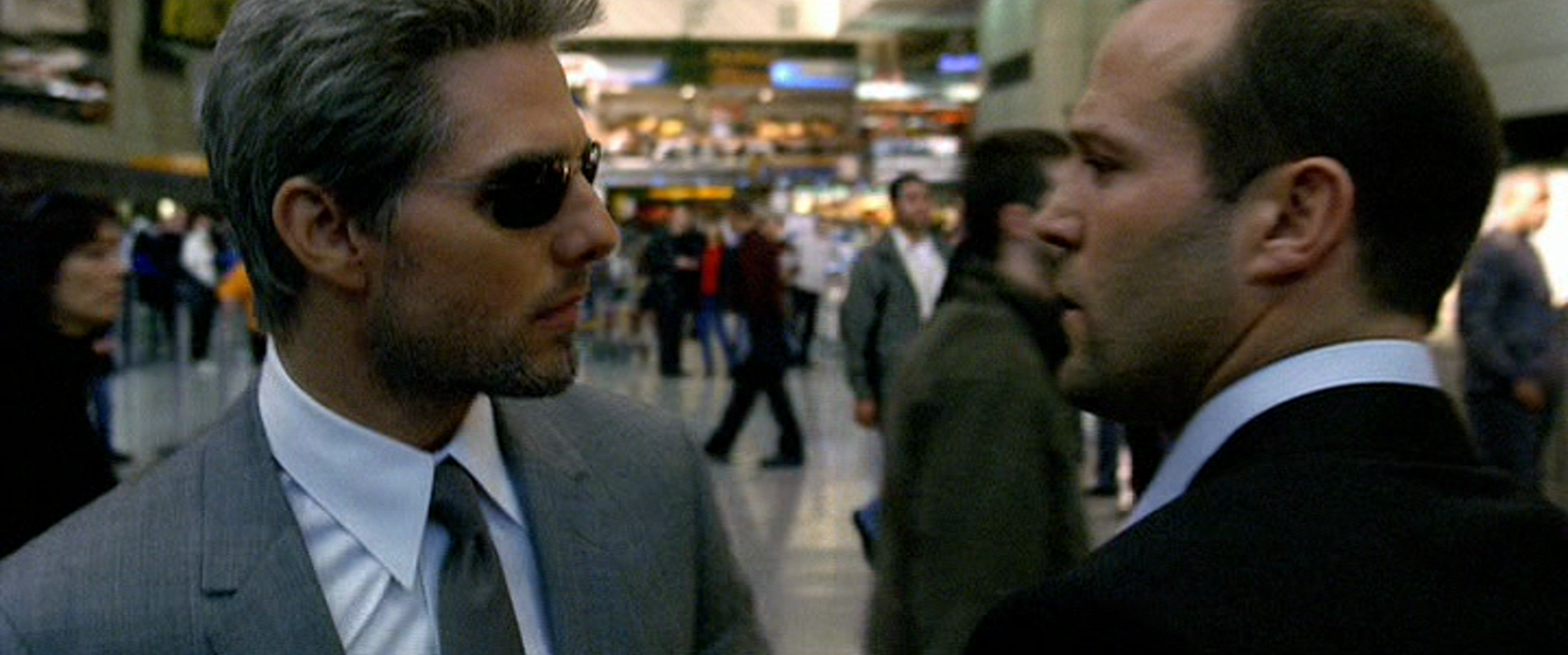
Watching Collateral the other night, I was struck again by the simplicity of its script, the amazing clarity of its high-def digital photography, the way Michael Mann is able to wring supple, nuanced performances from his two stars, Tom Cruise and Jamie Foxx, and... holy crap, is that Jason "Lock, Stock and Two Smoking Barrels" Statham switching briefcases with Tom Cruise at the beginning of the movie? Or did my eyes just deceive me? The man may only show his face for about 15-20 seconds or so, but... yep, a quick scan of IMDb shows that Statham is indeed in the movie (credited only as "Airport Man"). My interest piqued, I check IMDb again, and see that Statham's Collateral cameo comes only one year after The Italian Job (2003) and two years after The Transporter (2002). So he'd already made a name for himself by the time 2004 rolled around - why such a bit part in an otherwise major motion picture? Was it a favor to the director? A favor to Cruise? A way of passing the baton from one action hero to another?

Saturday, May 10, 2014

... FOR "FRANCHISE FACE-OFFS (PART 16 - 'SPIDER-MAN' EDITION)"

The fun of the Spider-Man comics has always been that Peter Parker is intrinsically One of Us. We just may be too modest to admit it. We all feel the awkwardness of our teenage years, we all dream of greater power and responsibility, we all yearn for the courage and the conviction to swoop in and save the day. Swinging through the spires and the skyscrapers of New York City, Peter's world feels grounded in the everyday (well, as "everyday" as a kid in a red-and-blue leotard fighting crime, anyway), and his quips and his wisecracks give him the edge over his enemies, not only stronger and faster but smarter and wittier than they are too. With skills like that, who wouldn't want to be Spider-Man?

Despite his enormous popularity, however, the concept for Stan Lee and Steve Ditko's iconic creation almost didn't make it off the ground. When pitching his initial ideas for the character, Lee recalls that his publisher, Martin Goodman, asked, "Don't you understand what a hero is?" Goodman felt that the idea of a teen-aged superhero - especially a high school nerd who was unpopular with the ladies - wouldn't appeal to readers, since most teens in comic books (think "Bucky" Barnes or Dick Grayson) served only as sidekicks to more experienced crimefighters. Little did he realize that audiences were clamoring for a character they could call their own; unlike Superman, say, with his godlike powers and chiseled physique, or Batman, with his unlimited gadgets and millions of dollars at his disposal, Peter Parker struggled with more conventional problems, like passing his classes or trying to hold down a job. And comic book fans fell immediately in love with him. Spider-Man debuted in Amazing Fantasy #15 in June 1962 and sold in record numbers (in 2011, a near- mint edition of this issue sold for $1.1 million to a private collector). He has since become Marvel's flagship character and company mascot, appearing in multiple comic titles, cartoons, radio plays, movies, books, video games, even a Broadway musical (with music by U2's Bono and The Edge).


Friday, March 14, 2014

... FOR "DETAILS YOU PROBABLY NEVER NOTICED IN POPULAR FILMS BEFORE ('TERMINATOR 2' EDITION)"

In which we take a look at the movies of yesteryear and bring some of their more subtle, less- noticeable idiosyncrasies to the fore. Do some of your favorite films exist in the memory purely as entertainment and nothing more? Well, look again...

A blockbuster to end all blockbusters, James Cameron's Terminator 2: Judgment Day opened in the summer of 1991 and blew away all its competition, earning $519.8 million worldwide (or roughly $888 million when adjusted for inflation). Cameron and his cinematographer, Adam Greenberg, though, had more up their sleeve than state-of-the-art special effects or rock-'em-sock-'em heavy metal action; they infused the movie with a slick, subtle color scheme that mimics the emotions of the characters.

Tuesday, January 14, 2014

... FOR "SHIA LaBEOUF-ISMS" (OR, "HOW TO PLAGUARIZE OTHER PEOPLE'S WORK AND PAY THE PENALTY FOR IT") - UPDATED!

Actor/rabble rouser/fledgling filmmaker Shia LaBeouf got himself into a bit of hot water last month, when the former Transformers star was accused of plagiarizing someone else's work for HowardContour.com, his 12-minute short about the trials and tribulations of an Internet movie critic. Just to be clear: LaBeouf flat out stole the plot of Daniel Clowes's 2007 comic book Justin M. Damiano, including specific frames and entire lines of dialogue, and tried passing it off his own. (Clowes's name is conspicuously absent from the film itself, and never once during interviews did LaBeouf mention Justin M. Damiano as his source material.)

Tuesday, January 22, 2013

... FOR "FRANCHISE FACE-OFFS (PART 15 - 'X-MEN' EDITION)"

If Batman & Robin signaled the death of the Comic Book Movie, then X-Men (2000) is undoubtedly its rebirth - a reverent, star-studded extravaganza that rang the box office bell in ways very few people expected. Sure, there were attempts to revive the genre in between - Blade (1998) springs to mind, starring Wesley Snipes, or Mystery Men (1999), with Ben Stiller and William H. Macy. But those were low-key adaptations of lesser-known characters, not the big-budget, big-name properties fans took to heart.

Consider, too, how the biggest Comic Book films up to that point, Richard Donner's Superman: The Movie (1978) and Tim Burton's Batman (1989), seemed to spawn only Batman and Superman sequels. X-Men opened the floodgates for future box office spectaculars including Spider-Man (2002), Daredevil (2003), Hulk (2003), Fantastic Four (2005), reboots of the Batman and Superman franchises, plus Marvel Comics' Cinematic Universe, culminating in The Avengers (2012) - currently the third highest-grossing film of all time. Superman '78 may have set the template for comic book verisimilitude (Richard Donner was an executive producer on X-Men), but it was X-Men that permanently whet the public's appetite for cinematic superheroics.


Monday, June 18, 2012

... FOR "MARKETING PLOYS AND THE ART OF THE MONEY SHOT"

I happened to catch Independence Day on AMC last week (well, most of it anyway), and was shocked to re-discover how simplistic the movie plays, and how that simple-mindedness works largely in its favor. It's deliberately designed as a callback to those big-budget, star-studded disaster flicks of the 70's, only this time with aliens, and like Earthquake or The Towering Inferno, it appeals to our most basic desire to watch stuff blow up. Each individual character motivation can be summed up in six words or less (Wants His Ex-Wife Back, Wants To Be An Astronaut, Wants To Be A Better President), the special effects (mostly model work, minimal CGI) are impressive in an old-fashioned Irwin Allen sort of way, and its big emotional crescendos ("Today we celebrate... our Independence Day!") are painted in the biggest, broadest strokes. Lump them all together, and it's no wonder audiences went absolutely ape for it.

Thursday, April 19, 2012

... FOR "CG ATROCITIES (AND THOSE WHO COMMIT THEM)"

Confession: I don't care much for CGI. At least not in the way most filmmakers tend to use it these days, which is too much and too often. Like any cinema tool – music, art direction, cinematography, editing, costume design, even A-list actors – special effects should always be used as a means to support a story, not as the focus of it. And it's a shame how so many people have apparently lost sight of that.

Granted, it's a tricky mix to get just right. While some directors seem to get it (Steven Spielberg, Christopher Nolan, even pre-Avatar James Cameron spring to mind), others have simply lost the ability to rely on anything else (cough-George Lucas-cough). We've come a long way since the days of Jurassic Park and Terminator 2, when CGI still had the power to shock and surprise us - to make the fantastical seem fathomable. Now that anything and everything can be accomplished via CGI, from exploding planets to spaceships to kitchen utensils to tabletops, my question is: Should it?

Sunday, March 18, 2012

... FOR "THAT SINKING FEELING... IN 3D!"

We now take a break from our regularly scheduled programming to bring you... James Cameron's Titanic on Facebook!

Has anybody seen this? Chances are, you probably have: As of this writing, the Titanic Facebook page has been "liked" 18,181,157 times since its debut on May 19, 2011. Eighteen million! Am I reading that right? Do that many people still care about Titanic? Sure, the thing made about a gazillion dollars when it first came out, and deservedly captured the imagination of millions of movie-goers worldwide, but still. How many people who "liked" the page were even alive when it first hit theaters 15 years ago? 

Monday, February 14, 2011

... FOR "REMAKES YOU NEVER KNEW WERE REMAKES"


A few weeks back, while surfing through our NetFlix account on the Wii, I happened across Waterworld in the Sci-Fi Recommendations section. It'd been a while since I'd seen it, and my memories of it aren't at all venomous, so I thought, "Yeah, I'll add that to the Instant Queue." I mean, why not, right? I'm paying my $8.99 a month. Might as well get my money's worth. And I know you're thinking: "Waterworld. Isn't that the Kevin Costner fish movie that came out, like, twenty years ago? Don't you have better things to do?" Well, yes and yes – but the truth is, you never really know what mood will strike you in your spare time.

When the movie came out in the summer of 1995, it just about sunk under the weight of its troubled production history. Its budget soared to $175 million – until Titanic, the most expensive motion picture ever made – because of costly delays during filming. Infighting among cast and crew plagued the shoot, most notably between Costner and director Kevin Reynolds, whose friendship had already been strained while filming their last venture, Robin Hood: Prince Of Thieves. The screenplay was being rewritten on a daily basis, with script-polisher Joss Whedon (Buffy The Vampire Slayer) describing his time on set as "seven weeks of hell." With that kind of publicity, the movie was either destined to become one of the biggest flops in Hollywood history, or a massive hit peaked by audience curiosity. Actually, it turned out to be neither – Waterworld grossed over $264 million worldwide, barely enough to recoup its production and advertising budgets.