BLOGGER TEMPLATES AND TWITTER BACKGROUNDS
by D.W. Lundberg

Showing posts with label IMAGES. Show all posts

Friday, November 6, 2015

... FOR "DETAILS YOU PROBABLY NEVER NOTICED IN POPULAR FILMS BEFORE ('DIE ANOTHER DAY' EDITION)"

One of the most derided entries in the James Bond canon, Die Another Day opened in November of 2002 to coincide with 007's 40-year cinematic anniversary. It was Pierce Brosnan's fourth and final outing as the inimitable superspy, and the first Bond film to embrace the use of CGI for its action scenes (which was a major source of said derision). Yet despite the misgivings of critics and Bond fans alike, Die Another Day managed to gross $432 million worldwide - the highest-grossing franchise entry up to that point (unadjusted for inflation). The plot, for the uninitiated, centers around a failed mission in North Korea during which Bond is captured and held prisoner for 14 months. Once released, Bond finds he's been disavowed by MI6 and that his 00 status has been rescinded... but never one to shrink from a challenge (ahem), decides to go "rogue" in order to clear his name and discover the identity of the agent who betrayed him. Along the way, Bond makes friends with a bikini-clad sidekick, engages his enemy in a “winner takes all” sporting match, drives around in his patented Aston Martin with built-in patented ejector seat, hangs off cliffs, has his cover blown by facial recognition software, and disarms a solar-powered superweapon (not in that order).

If any of that sounds at all familiar to you, congratulations: you've seen enough James Bond in your lifetime to know that Die Another Day cribs from the best (and some of the not-so-best) of them. (And those are: Bond going rogue = Licence To Kill; betrayed by fellow agent = GoldenEye; bikini sidekick = Dr. No; sporting match + ejector seat = Goldfinger; cliff-hanging = For Your Eyes Only; facial recognition = A View To A Kill; solar superweapon = The Man With The Golden Gun.) But is this a case of pure laziness on the filmmakers' part, or simply par for the course at this point? Like any good soup or stew, we expect our Bond films to be stuffed with all the familiar ingredients - a sprinkle of outlandish gadgetry here, a dollop of double entendres there, three cups of vehicular mayhem over there. And while I admit having a soft spot for the film itself (I like the devil-may-care, adrenaline-pumping pace of the thing, despite the ridiculousness of the plot), I'll also be the first to admit that Die Another Day, more than The World Is Not Enough before it, plays more like a Greatest Hits assemblage of previous Bond adventures than an actual movie.

The franchise's 40th Anniversary might have more to do with this than we initially suspected. The makers of Die Another Day had two simple requirements: one, make the movie accessible to The Fast And The Furious set, and two, include enough homages to Bond's cinema past while trying to appeal to the The Fast And The Furious set. As such, 007's 20th big-screen endeavor is not only loaded with crash-zooms and extreme sports sequences but also references to every (official) Bond film ever made. Some of these are subtle - others, not so much. Then again, James Bond has never been one for subtlety.

Tuesday, February 3, 2015

... FOR "MILESTONES AND SUCH"

Finding The Wrong Words celebrates an important milestone today: 5 years up and running! Hard to believe when I started this blogging adventure on February 3, 2010, that we'd still be going strong all this time later. Thanks to everyone who's given their unwavering support over the last half decade. I appreciate your comments and your readership more than I can possibly express. Now let's keep it going for another five years and beyond!

Tuesday, July 22, 2014

... FOR "DETAILS YOU PROBABLY NEVER NOTICED IN POPULAR FILMS BEFORE ('DIE HARD' EDITION)"

A continuation on a theme, again, as we take a closer look at Die Hard (1988). Unquestionably one of the most influential action films of the 80s (along with Raiders Of The Lost Ark and John Woo's The Killer), John McTiernan's game-changing box office blockbuster snuck up on audiences worldwide, catapulting Bruce Willis into superstardom and launching its own brand of wannabes and knockoffs ("Die Hard... on a boat!" "Die Hard... on a plane!" "Die Hard... in a hockey arena!" ). To judge the film by its countless clones and imitators, though, is to diminish its special contributions to the genre.

Aside from the obvious, which we'll cover in a future Franchise Face-Off (or, if you prefer, you can read Matt Zoller Seitz's in-depth appreciation of its 25th anniversary here), Die Hard is a masterpiece of spatial composition and the characters' relation to the camera frame. The production design by Jackson DeGovia, for example, or McTiernan's staging of certain shots, which constantly arranges actors and objects in trianglular formations:

Friday, June 6, 2014

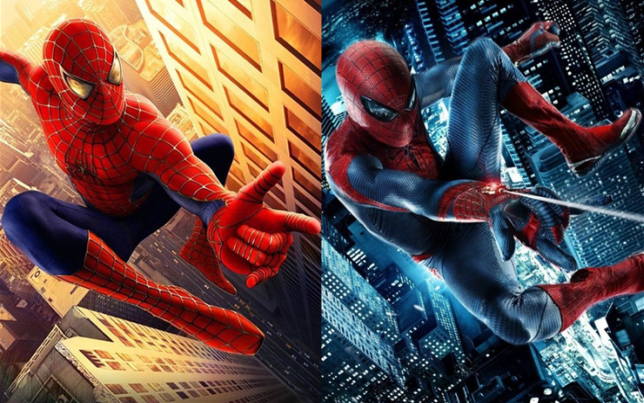
... FOR "A TALE OF TWO SPIDER-MAN(S)"

And again I find myself facing a conundrum: How, exactly, do I express my ardor and affection for one of the world's greatest comic book characters within the confines of a single blog post? Answer: I don't. As I've mentioned elsewhere on this site, simply talking about film, writing about it, isn't enough to do it justice. For what are motion pictures if not a purely visual medium? That's especially true of Comic Book Movies, which, like their source material, are meant to be experienced visually. Where's the fun, for example, in describing a scene from Sam Raimi's Spider-Man - in which all the characters show up for Thanksgiving dinner wearing each other's colors - when I can simply show it to you instead?

It may seem hard to believe, but Raimi's original Spider-Man turned 12 years old just this month. Harder still when you realize his entire Spider-Man trilogy lasted only five years, from 2002-2007. Together, they've grossed over $2.4 billion at the box office worldwide. They undoubtedly did their part to shape the current Comic Book Movie climate as we know it. And yet, since the 2012 reboot, some of Raimi's choices have been called into question, in particular his decision to skimp on the grittier, more psychological aspects of the character.

Saturday, April 19, 2014

... FOR "DETAILS YOU PROBABLY NEVER NOTICED IN POPULAR FILMS BEFORE ('SPIDER-MAN' EDITION)"

In which we take a look at the movies of yesteryear and bring some of their more subtle, less- noticeable idiosyncrasies to the fore. Do some of your favorite films exist in the memory purely as entertainment and nothing more? Well, look again...

The first thing you notice about comic books is that they're color coded. Sure, it's the characters and the storylines that keep you coming back month after month, issue after issue, but it's the bright, shiny colors that catch your attention first. In this regard, the colorists' job is just as important as the penciler's, or the script writer's. Think about it: without Superman's red-and-blue getup or the Hulk's green florescent skin, would you have given them a second glance?

Friday, March 14, 2014

... FOR "DETAILS YOU PROBABLY NEVER NOTICED IN POPULAR FILMS BEFORE ('TERMINATOR 2' EDITION)"

In which we take a look at the movies of yesteryear and bring some of their more subtle, less- noticeable idiosyncrasies to the fore. Do some of your favorite films exist in the memory purely as entertainment and nothing more? Well, look again...

A blockbuster to end all blockbusters, James Cameron's Terminator 2: Judgment Day opened in the summer of 1991 and blew away all its competition, earning $519.8 million worldwide (or roughly $888 million when adjusted for inflation). Cameron and his cinematographer, Adam Greenberg, though, had more up their sleeve than state-of-the-art special effects or rock-'em-sock-'em heavy metal action; they infused the movie with a slick, subtle color scheme that mimics the emotions of the characters.

Thursday, December 26, 2013

... FOR "DETAILS YOU PROBABLY NEVER NOTICED IN POPULAR FILMS BEFORE ('HOME ALONE' EDITION)"

For Home Alone (1990), director Chris Columbus wanted to give the film a warm Christmas feel. So he drenched the production design in greens and reds, the better to imbue the viewer with the spirit of the season:

Thursday, November 7, 2013

... FOR "MOVIE COINCIDENCE OF THE DAY #2"

In which we take a look at a series of odd movie coincidences - scenes, jokes, dialogue, even specific camera shots shared between two seemingly unrelated films. Anyone who's sat through a particular scene in a movie and thought, "Gee, haven't I seen someone do this somewhere before?" will know exactly what I'm talking about.


Continuing with our horror movie theme (a week after Halloween - so sue me), I offer this comparison between two "classics" of the genre, Tobe Hooper's Poltergeist (1982) and Wes Craven's A Nightmare On Elm Street (1984). One is a haunted house movie in which a middle-class American family find themselves under attack from a malevolent spirit. The other is an atypical slasher flick in which a group of all-American teenagers fall victim to a razor-fingered psychopath who kills them in their sleep. Couldn't be more different, right? Yet they share a single scene on common - in which a character is dragged across the walls and ceiling of her bedroom by an unseen demonic force:

Sunday, October 13, 2013

... FOR "MOVIE COINCIDENCE OF THE DAY #1"

First in a series of blog posts in which we take a look at odd movie coincidences - scenes, jokes, dialogue, even specific camera shots shared between two seemingly unrelated films. Anyone who's sat through a particular scene in a movie and thought, "Gee, haven't I seen someone do this somewhere before?" will know exactly what I'm talking about.

We begin with The Last Samurai (Edward Zwick, 2003) and Oblivion (Joseph Kosinski, 2013), two films as distinctly different as they come. One is a historical drama set in 19th Century Japan; the other a special effects-laden sci-fi parable set 60 years in our future. Both, however, feature the same lead actor (Tom Cruise), and conclude with a strikingly similar series of shots.

In both, our hero is able to make it back, after a Long Personal Journey, to the woman he loves. As she works in the garden (with her offspring looking on), they spot each other from a distance. Each film ends on Cruise's goo goo-eyed expression:

Monday, April 29, 2013

... FOR "TWENTY YEARS LATER: 'JURASSIC PARK' (AN APPRECIATION - OF SORTS)"

Jurassic Park gets a fancy new upgrade on Blu-ray this month (in 3D!) after raking in an additional $42 million in U.S. theaters (including one week in IMAX) since April 5th. I haven't been too enthusiastic about these post-converted 3D re- releases so far (read here for evidence on that), but I have to admit seeing Steven Spielberg's 1993 dinosaur epic again on the big screen might have its perks. (That sublime raptors-in-the-kitchen climax, in full-on jump-at-your-face three-dimensional glory? Yes, please!) I've resisted the urge to buy a ticket, though, since I happened to catch the movie twice on TV during the last week (once on DVD, and the other during its regular rotation on Starz), and I realized that my appreciation for it hasn't dwindled a bit since my initial viewing 20 years ago.

Even on the small screen, to witness Jurassic Park again is to be reminded of two things: one, that it helped change the face of CG special effects work as we know it, and two, it's a prime example of Spielberg's unparalleled genius as a virtuoso action director. No one can deny that the dinosaurs are the stars of the show - a glorious mix of computer-generated images, animatronics, and sound design. But without Spielberg's sly signature wit Jurassic Park might have turned out to be just another mindless monster movie.

Thursday, April 4, 2013

... FOR "IMAGES ('X-MEN' 2000-11 EDITION - PART THREE)"

Part Three of our X-Men movie retrospective, in which we take a visual tour of the franchise's special (and not-so-special) pleasures.


Hidden gems and history lessons. Callbacks and cameo appearances. The X-Men movies are perhaps the most richly textured of all comic book franchises, with plenty of subtext and shout-outs for fans and non-fans alike. Take another look, though, and you'll see the films cribbing not just from themselves but from other popular series as well.


Fearful Symmetry


I spoke last time about the X-Men of First Class learning firsthand from President Kennedy, via television, of the impending Cuban Missile Crisis. Here it is again, in case you missed it:

Wednesday, March 6, 2013

... FOR "IMAGES ('X-MEN' 2000-11 EDITION - PART TWO)"

Part Two of our X-Men movie retrospective, in which we take a visual tour of the franchise's special (and not-so-special) pleasures.


So we've already established some of the many Easter Eggs and character cameos which make up Marvel's mutant movie universe. This includes, during an early sequence in X-Men: The Last Stand, a direct homage to Claremont/Byrne's two-part Days Of Future Past, in which our heroes are rounded up and herded into WWII-type internment camps.

That the latest X-Men sequel to enter production is also called Days Of Future Past raises some interesting theoretical questions, namely: Did they plan this sort of thing from the beginning, with every intent to revisit this particular story thread in the future? Or did the producers of X-Men 3 simply include the scene as a shout-out to fans, because they couldn't find room for it elsewhere? Evidence seems to suggest the latter, though wouldn't it be fun, in today's post-Avengers climate, to think that the makers of this $1.9 billion franchise had a particular endgame in mind?

Saturday, February 9, 2013

... FOR "IMAGES ('X-MEN' 2000-11 EDITION - PART ONE)"

Some final thoughts on X-Men before we move on to bigger (and brighter?) things. I don't know if these types of posts will follow every Franchise Face-Off from this point on, but these Comic Book movies have definitely sparked my interest as of late. Perhaps this is because both comic books and the cinema are purely a visual medium: It's the images that catch your eye, after all, and if the story connecting them together happens to keep your attention, then so be it. That's just gravy for all those concerned. The best CBMs understand this and deliver on it, twofold.

The X-Men movies, like Batman and Superman before them, have gone through many different permutations over the years, each time trying desperately to please fans of the comic and kowtow to the demands of the cinema. Below, and during the next two X- centric posts, we cover a few examples of how the filmmakers attempted to do both:

Saturday, December 8, 2012

... FOR "IMAGES ('BATMAN' 1989-97 EDITION - PART FOUR)"

Part Four of our Burton/Schumacher retrospective, in which we take a visual tour of the 1989-97 series' special (and not-so-special) pleasures.

One truism about comic books - or any serialized form of entertainment - is that they're always in flux. Readership dwindles, tastes splinter off and mature, and publishing houses find themselves in a constant struggle to stay one step ahead of the public - to remain pertinent, say, or keep current with the ever-changing media climate. It's why we have so many iterations, spin-offs and incarnations of the same old titles: to please any number of fans at any given moment.

Tuesday, November 27, 2012

... FOR "IMAGES ('BATMAN' 1989-97 EDITION - PART THREE)"

Part Three of our Burton/Schumacher retrospective, in which we take a visual tour of the 1989-97 series' special (and not-so-special) pleasures.

The first thing you should know about Batman Forever is that Tim Burton and Joel Schumacher are friends. Or mutual acquaintances, at least, depending on the stories you read. So when Schumacher was handed the reins to Warner Bros' lucrative Bat-franchise, he immediately sought Burton's approval. Burton met with the director and screenwriters Lee Batchler and Janet Scott Batchler to discuss the tone of the film, and while this may be the extent to which Burton was involved (he's listed as a "producer" in the credits), it's safe to say he gave them his blessing.

Tuesday, October 23, 2012

... FOR "IMAGES ('BATMAN' 1989-97 EDITION - PART TWO)"

Part Two of our Burton/Schumacher retrospective, in which we take a visual tour of the 1989-97 series' special (and not-so-special) pleasures.


It was the summer of 1989, and the hype was inescapable: backpacks, posters, video games, candy dispensers - you couldn't walk two feet without bumping into Batman paraphernalia of some kind. (According to this report, Batman merchandise earned over $500 million in retail that year.) Little did marketing pundits realize that the Caped Crusader's long-awaited return to theater screens would turn out to be such a pop culture phenomenon; Premiere magazine, in fact, in their annual summer box-office prediction issue, guessed that Batman would place 3rd - after Ghostbusters II and Indiana Jones And The Last Crusade, respectfully - in ticket sales from May to August. (Tim Burton's block-busting juggernaut wound up grossing $251.2 million in the U.S. - $54 million more than Crusade, and $138 million more than Ghostbusters.)

Standing outside the Alpine Cinema in Brooklyn with my aunt and uncle, you could feel the anticipation crackling in the air. It was midnight on June 24th (getting tickets on opening day was next to impossible) and I can tell you the crowd wasn't just there to watch a movie - they came to be part of an event, a communal experience unlike anything since the original Star Wars. That same excitement carried into the theater too. New York audiences have always been a little more... rambunctious than other places, but this was something different. They cheered when the lights went down. They cheered when the "Batman" title card came up on the screen. They hooped and hollered at the first appearance of the Batmobile. And they rose to their feet and applauded when the lights came up again.

Tuesday, October 16, 2012

... FOR "IMAGES ('BATMAN' 1989-97 EDITION - PART ONE)"

As it often happens when I write for the blog, my thoughts have a nasty habit of getting away from me. Sometimes a particular format will steer me in the opposite direction, or change the particular theme, of a piece that I'm writing. Most times, the final published post will end up looking drastically different from what I originally intended. How, for instance, do I adequately express my undying affection for a certain caped crusading comic book character when the article in question is so clearly about all the behind-the- scenes politics that brought him to the screen?

The Burton/Schumacher Batmans have always held a peculiar fascination for me - not just for how much they got "right" but also for what they got so blatantly, emphatically "wrong." Story-wise, they're a mess, with almost total disregard for comic book canon. Visually, though, they are a triumph - a textbook case of style over substance. (Even Batman & Robin, for all its gaudy garishness, in never dull to look at. Especially with the sound turned off.)