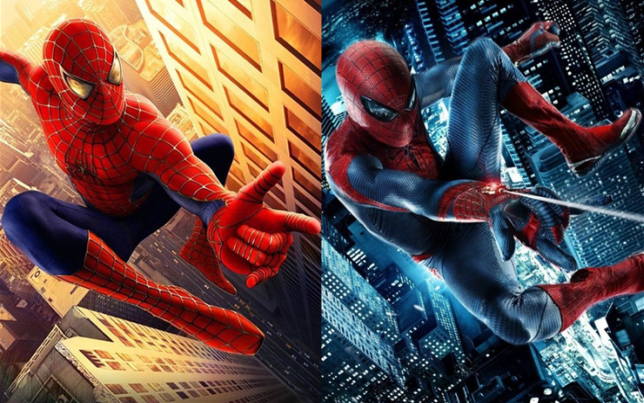
It may seem hard to believe, but Raimi's original Spider-Man turned 12 years old just this
month. Harder still when you realize his entire Spider-Man trilogy lasted only five years, from 2002-2007.
Together, they've grossed over $2.4 billion at the box office worldwide. They
undoubtedly did their part to shape the current Comic Book Movie climate as we
know it. And yet, since the 2012 reboot, some of Raimi's choices have been
called into question, in particular his decision to skimp on the grittier, more
psychological aspects of the character.
Friday, June 6, 2014
... FOR "A TALE OF TWO SPIDER-MAN(S)"
Saturday, May 10, 2014
... FOR "FRANCHISE FACE-OFFS (PART 16 - 'SPIDER-MAN' EDITION)"
The fun of the Spider-Man comics has always been that Peter Parker is intrinsically One of Us. We just may be too modest to admit it. We all feel the awkwardness of our teenage years, we all dream of greater power and responsibility, we all yearn for the courage and the conviction to swoop in and save the day. Swinging through the spires and the skyscrapers of New York City, Peter's world feels grounded in the everyday (well, as "everyday" as a kid in a red-and-blue leotard fighting crime, anyway), and his quips and his wisecracks give him the edge over his enemies, not only stronger and faster but smarter and wittier than they are too. With skills like that, who wouldn't want to be Spider-Man?
Despite his enormous popularity, however, the concept for Stan Lee and Steve Ditko's iconic creation almost didn't make it off the ground. When pitching his initial ideas for the character, Lee recalls that his publisher, Martin Goodman, asked, "Don't you understand what a hero is?" Goodman felt that the idea of a teen-aged superhero - especially a high school nerd who was unpopular with the ladies - wouldn't appeal to readers, since most teens in comic books (think "Bucky" Barnes or Dick Grayson) served only as sidekicks to more experienced crimefighters. Little did he realize that audiences were clamoring for a character they could call their own; unlike Superman, say, with his godlike powers and chiseled physique, or Batman, with his unlimited gadgets and millions of dollars at his disposal, Peter Parker struggled with more conventional problems, like passing his classes or trying to hold down a job. And comic book fans fell immediately in love with him. Spider-Man debuted in Amazing Fantasy #15 in June 1962 and sold in record numbers (in 2011, a near- mint edition of this issue sold for $1.1 million to a private collector). He has since become Marvel's flagship character and company mascot, appearing in multiple comic titles, cartoons, radio plays, movies, books, video games, even a Broadway musical (with music by U2's Bono and The Edge).
Saturday, April 19, 2014
... FOR "DETAILS YOU PROBABLY NEVER NOTICED IN POPULAR FILMS BEFORE ('SPIDER-MAN' EDITION)"
In which we take
a look at the movies of yesteryear and bring some of their more subtle, less- noticeable idiosyncrasies
to the fore. Do some of your favorite films exist in the memory purely as
entertainment and nothing more? Well, look again...
The first thing you notice about comic books is that they're color coded. Sure, it's the characters and the storylines that keep you coming back month after month, issue after issue, but it's the bright, shiny colors that catch your attention first. In this regard, the colorists' job is just as important as the penciler's, or the script writer's. Think about it: without Superman's red-and-blue getup or the Hulk's green florescent skin, would you have given them a second glance?
Monday, April 14, 2014
... FOR "EXCUSES, EXCUSES" (A BOOK REVIEW OF "THE OFFSPRING," BY R.J. CRADDOCK)
As someone who's tried his hand at writing a novel or two, I can tell you this: it's no easy feat. I barely have the patience (or the brain power) at this point to hammer out a couple nonsensical paragraphs for the blog, let alone 300-500 pages worth. More than that, being able to keep a plot rolling for that long, or characters worth the trouble, is a task so Herculean I can scarcely understand how authors like Stephen King or James Patterson or (heaven forbid) Stephenie Meyer are able to do so on a regular basis. It takes tremendous talent and effort to do what these people do, yet ultimately what binds us together boils down to one simple thing: our obsession with the written word.
Born in Oaka
Tamuning, Guam (where her father worked as an art teacher), Ruth
"R.J" Craddock has every excuse never to attempt the Next Great
American Novel - marriage, kids, housework (and all the exhaustion that
entails), not enough hours in the day, you name it. Yet she also suffers from a
disability only 17% of the population can claim to share: dyslexia, diagnosed
at a very young age. Determined to never let it get the best of her, or define
her in any way, Ruth was able to maintain a 4.0 GPA by her sophomore year in
high school, and at 29, published her first novel, The Forsaken, Book One in
her proposed Children Of Cain series. Now just a year later comes its sequel,
The Offspring, a sure sign that her dyslexia has no chance of holding her back.
(She joins a select group of dyslexic authors throughout history, including
Agatha Christie, Hans Christian Anderson and William Butler Yeats.)
Friday, March 14, 2014
... FOR "DETAILS YOU PROBABLY NEVER NOTICED IN POPULAR FILMS BEFORE ('TERMINATOR 2' EDITION)"
In which we take
a look at the movies of yesteryear and bring some of their more subtle, less- noticeable idiosyncrasies
to the fore. Do some of your favorite films exist in the memory purely as
entertainment and nothing more? Well, look again...
A blockbuster to end all blockbusters, James Cameron's Terminator 2: Judgment Day opened in the
summer of 1991 and blew away all its competition, earning $519.8 million worldwide
(or roughly $888 million when adjusted for inflation). Cameron and his cinematographer,
Adam Greenberg, though, had more up their sleeve than state-of-the-art special effects or rock-'em-sock-'em heavy metal action; they infused the movie with a
slick, subtle color scheme that mimics the emotions of the characters.
Subscribe to:
Posts (Atom)


